
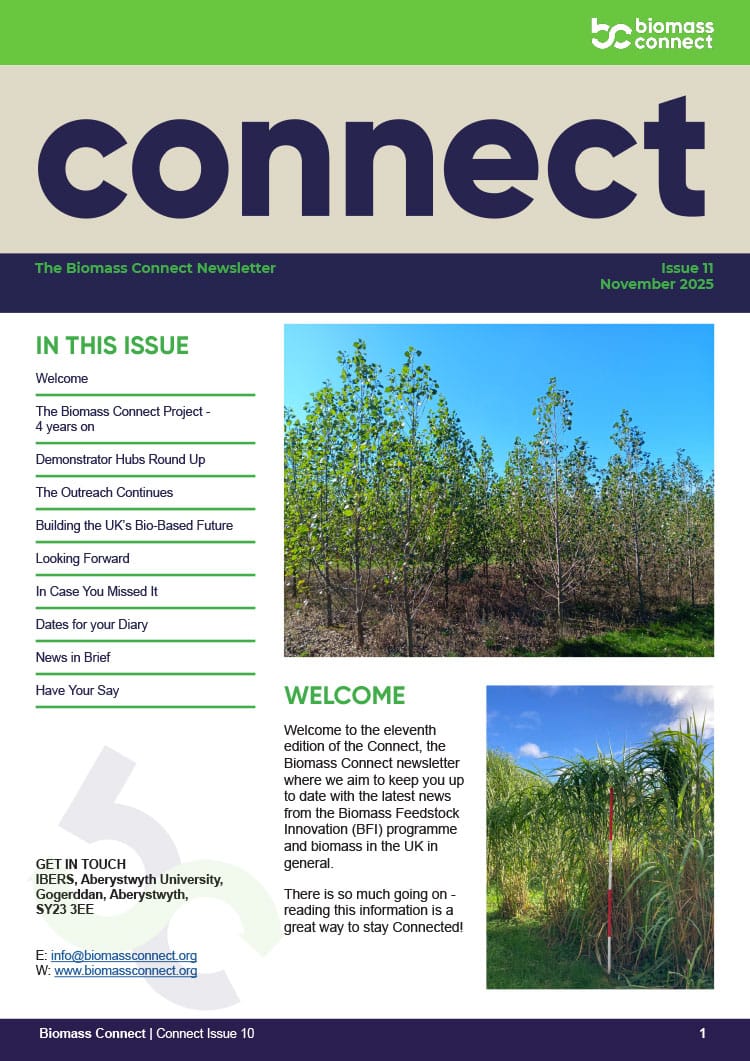
Issue #11 of the Connect Newsletter is now available. The Connect Newsletters contain updates on project activities, details of the latest events, and news from across the wider biomass industry.

October marked a clear transition into autumn across the Biomass Connect sites, with widespread senescence observed in most crops. Storm events early in the month (notably Storm Amy and Benjamin) caused localised wind damage, particularly to taller crops and weaker trees, though most sites reported minimal long-term impact. Pest pressures were low overall, with only isolated aphid clusters and insect activity noted. Phenotyping of Miscanthus and woody crops was carried out at multiple sites, providing valuable data on growth and senescence patterns.

The Forestry Commission has published a comprehensive new guidance document entitled “Protecting trees from mammal damage: technical guidance” (30 October) aimed at supporting landowners, woodland managers and advisers who are establishing new tree plantations or agro-forestry systems.

September marked the transition into autumn across the Biomass Connect sites, with many crops beginning to show signs of senescence while maintaining good overall health.
A new report from the energy consultancy ‘Regen’ highlights the crucial role of biomethane generation — from a range of feedstock sources — in helping to decarbonise sectors that are otherwise difficult to decarbonise.

The European Bioeconomy Alliance (EUBA) — a cross-sector alliance dedicated to advancing the bioeconomy and realising its full potential in Europe — has released a new report this month aiming to refute long-standing concerns surrounding the use of first-generation biomass crops.

Could a new contender quietly take root for its roles in biomass production. Data from a new study in Germany seems to think so. For years, in many countries maize has been the steadfast workhorse of bioenergy, feeding digesters and fuelling the renewable energy drives. But its once-reliable yields falter when you consider soil exhaustion and nutrient losses that leach into rivers and streams.

The Agroforestry Show 2025 provided an excellent opportunity for Biomass Connect to share knowledge and engage with a wide range of stakeholders. On the 10th and 11th of September Rothamsted Research (collaborators within the Biomass Connect wider project) were kind enough to incorporate a Biomass Connect presence on their stand.

August brought a mix of warm, dry spells and a few violent storms across the network, producing a clear split between robust growth in some crops and drought- or wind-driven stress in others. Management this month focused on routine tidy-ups and targeted interventions where pests, wildlife or weather had caused damage. Several sites also prepared for autumn respray/mowing programmes for underperforming grass plots.
A national workshop held on June 30th, 2025, brought together industry leaders, researchers, policymakers, and growers to discuss how the UK can build resilient, sustainable bio-based supply chains. The focus was clear: the UK must move away from fossil-based inputs and toward homegrown, renewable alternatives — with biomass crops playing a central role in this transformation.